Sudarshan Kadam, a PhD student in New Media, at the University of Aveiro, was selected to participate in the Let’s CHAOS course, implemented within the NAWA SPINAKER programme.
The Let’s CHAOS course offers an advanced learning pathway focused on Inclusive Systems Design, combining critical reflection, research methodologies, and interdisciplinary perspectives. As part of the programme, participants will attend an online component, followed by a fully funded on-site mobility period, in March, at Łódź University of Technology (Poland), an ECIU University.
Sudarshan’s PhD project’s “Interactive Shoppable Video strategies for specific markets- Portugal & Spain” is supervised by Professor Jorge Ferraz Abreu and Professor Telmo Silva.
This participation reinforces DigiMedia’s commitment to international collaboration, advanced doctoral training, and inclusive, forward-looking research practices.
The DigiMedia researcher Oksana Tymoshchuk outlined the mission of the UNI.AO Programme, in which the University of Aveiro is collaborating in the design of the first doctoral programme in Education in southern Angola, at the University of Huíla.
The DigiMedia researcher participated as a supervisor for three PhD students in the area of Educational Technologies, and promoted a seminar on the use of qualitative data analysis technologies, such as WEBQDA and some Artificial Intelligence tools.
The UNI.AO Programme, funded by the European Union with €13 million, supports the Angolan higher education system in the production of knowledge and the promotion of innovation. Implemented by the French technical cooperation agency Expertise France, the programme aims to contribute to the training of qualified professionals capable of addressing the country’s current and future challenges through the creation of new postgraduate programmes, research funding, and capacity-building initiatives in key areas.
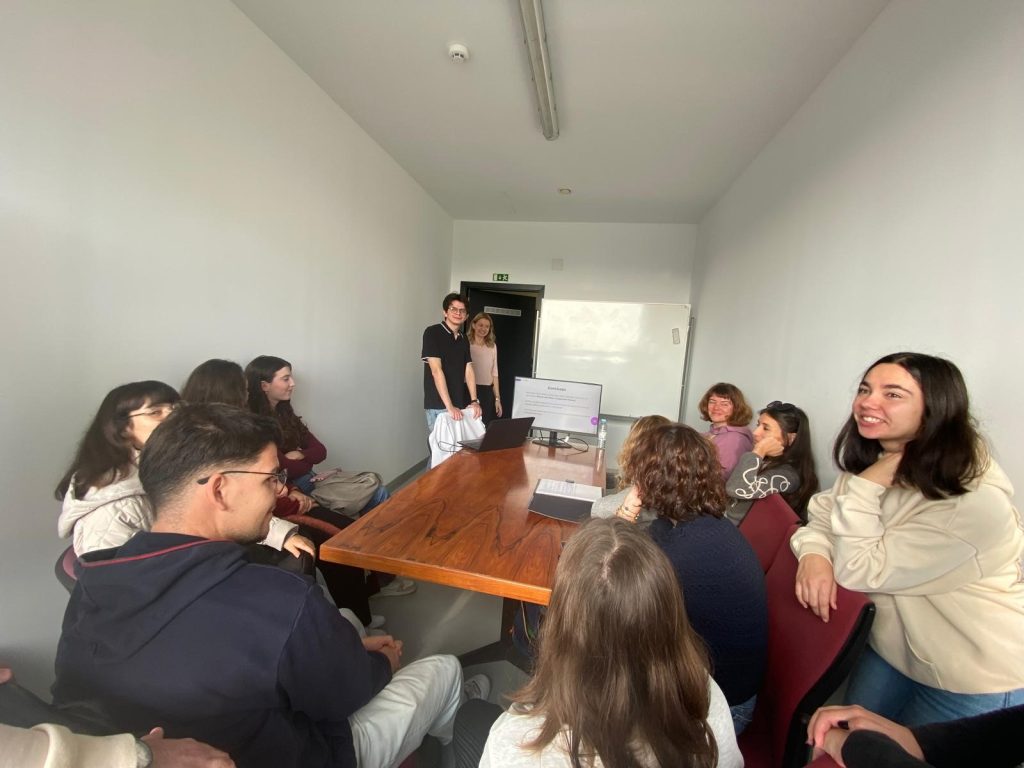
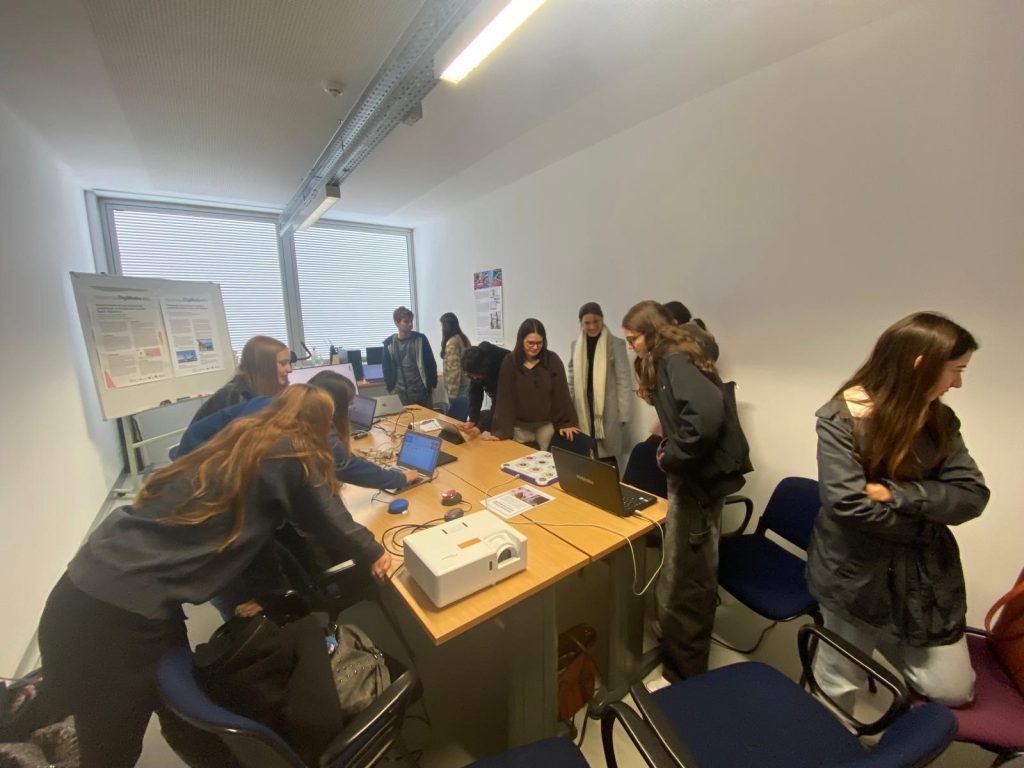
The UAInclusive laboratory team hosted approximately 25 students for a session dedicated to Assistive Technologies in Education, on November 19. This initiative was an invitation from the professor responsible for Curricular unit of “Neurodevelopment, Learning and Inclusion”, of the following Masters at the University of Aveiro: Master in Teacher Education – Pre-school education and 1st cycle of basic schooling; Master in Primary School Education and Mathematics and Natural Sciences in 2nd Cycle; Master in Primary School Education and Portuguese and History and Geography of Portugal in 2nd Cycle
In the first session, organized by the PhD student Francisca Lourenço, and the DigiMedia researchers Rita Oliveira and Oksana Tymoshchuk, students had the opportunity to learn about and experience various assistive resources and technologies available in the UAInclusive laboratory that support the teaching-learning process, as well as discuss pedagogical practices aimed at promoting accessibility and participation for all students.
On the other session, the PhD student, Lucius Vinicius-Filho, presented an inclusive prototype designed to support music education for children with Cerebral Palsy. The prototype, developed as part of his academic research, aims to support active participation in musical activities, promoting autonomy, creative expression, and greater accessibility in the learning process.
Participants also discovered several Virtual Reality projects developed at the XR Laboratory. These demonstrations were led by Professor Mário Varinhos, who highlighted how immersive technologies can be used for both teaching and research, and emphasized their transformative potential in educational contexts.
This initiative reinforces Digimedia and UAInclusive’s commitment to training future education professionals, contributing to the dissemination of knowledge and the construction of more inclusive and equitable educational environments.
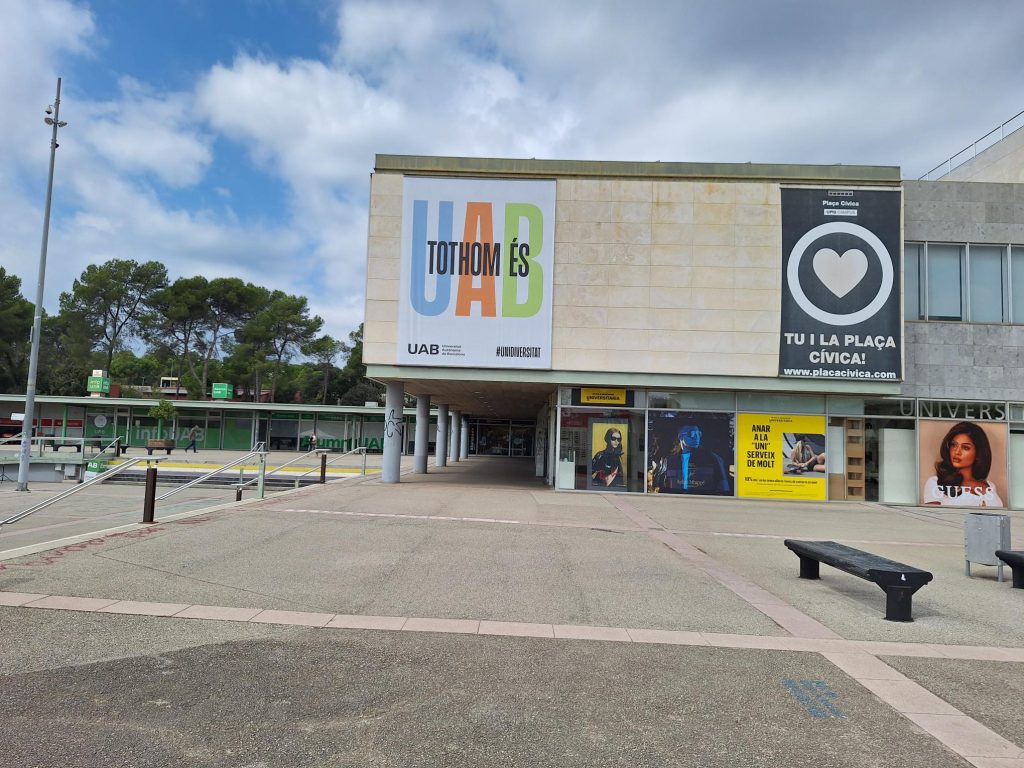
Sudarshan Kadam, PhD researcher at the University of Aveiro, is undertaking an Erasmus+ MindPhD Mobility at the Universitat Autònoma de Barcelona (UAB).
His mobility focuses on advancing research into interactive and shoppable video strategies, conducting surveys and expert interviews in the Spanish market, and exploring opportunities for a controlled experiment through UAB. He is also contributing to the development of a joint ECIU Seed Program proposal to strengthen research collaboration between UAB and UA.
This initiative exemplifies the Erasmus+ program’s commitment to enhancing academic excellence, internationalization, and cross-border research in New Media studies.
Sudarshan Kadam is a Phd student in New Media, supervised by Professor Jorge T. Ferraz de Abreu and Professor Telmo Silva.
Malmö University in Sweden hosted the 7th edition of the AI and Games Summer School. Among the participants was Cláudia Vale Oliveira, a student in the New Media PhD Program and a researcher at DigiMedia, who participated in this edition marked by innovation, creativity, and critical reflection on the role of artificial intelligence (AI) in gaming.
During five days, engineers, programmers, researchers, and game designers from both academia and industry shared knowledge and discussed the latest trends and influences in the use of AI in game development. The researcher from the University of Aveiro (UA), in addition to perspectives on player experience and interaction with agents through natural language processing, particularly highlighted the role of generative AI in the creative process and the ethical issues and challenges that artificial intelligence raises in game development. Issues such as authorship, boundaries, and ethical responsibility reinforce the importance of training professionals who are aware and critical of the possibilities and risks of AI integrated into interactive design. She also emphasized that it was “an incredible and inspiring week,” an experience she found “both engaging and challenging.”
In the final days of the event, participants were challenged to participate in the Game Jam. In this context the researcher Cláudia Oliveira and her team developed the Baloonce prototype, a collaborative game that aims to create balance, combating the sedentary lifestyle and burnout associated with professions like gaming developers, designers, and researchers, exploring the importance of moving and coordinating the body in a world where the mind and digital world are pushed to their limits. The project stood out among the participating teams, being selected as the best project of the Game Jam, a recognition that highlights the talent and capabilities of those involved. The project will soon be shared on Github.
This event was guided by leading figures in the field, such as Georgios N. Yannakakis, Julian Togelius, co-authors of the book Artificial Intelligence and Games, and Antonios Liapis. It was made possible thanks to the support of King, the UA, and DigiMedia, which provided the doctoral student with the opportunity to participate in this international summer school.
For the UA community, this participation represents not only an opportunity to enrich the student’s curriculum, but also a contribution to the development of new lines of research in the fields of new media, immersive games, experience design, and the ethics of artificial intelligence.
The Master in Communication and Web Technologies organized the open class “Launching and building digital products in an AI era”, on June 4th, with the participation of two former students of Multimedia and Communication Technologies: António Santos and Pedro Araújo, who became senior Web Developers and successful entrepreneurs, and creators of web products already available on the market.
The two invited speakers shared how they integrate AI tools throughout the design, development, and launch process of digital products.
This session was an opportunity for students to discover practical insights, tips, and tricks to supercharge their projects with AI.
The Unboxing_AI: an introduction workshop took place on May 21, in an online format and was attended by faculty members, researchers, PhD students, and other DigiMedia collaborators.
Joaquim Santos, an invited Assistant Professor in the Communication and Art Department, and researcher at DigiMedia, led the workshop, which main goal was to provide an accessible yet informed introduction to Large Language Models (LLMs), covering their evolution up to the Transformer architecture and the Generative Pre-Trained (GPT) models. The workshop explored codeless prompting techniques and the use of LLMs in academic research, including their limitations, risks, and the current regulatory framework.
The discussion also included the use and deployment of local LLMs versus cloud-based LLMs, weighing their advantages and disadvantages. A set of useful resources was presented to facilitate more effective interaction with AI systems.
In the hands-on session was an opportunity for participants to build knowledge using Open WebUI, integrate it into a Retrieval-Augmented Generation (RAG) system, and create a functional chatbot based on that knowledge.
Catarina Lélis has just completed her mobility program at KU Leuven, in Belgium, where she had the opportunity to strenghten the existing network. The DigiMedia researcher gave a lesson on visual strategies for UI/UX, a taster on the Impact Plan and led a workshop on dynamic Visual Identities.
In addition, Catarina Lélis participated in a workshop organized by Mintlab, a research unit of the Faculty of Social Sciences, with whom DigiMedia share several research interests.
Around 50 students from the 1st and 2nd year of the Degree in Digital Educational Technologies at ISCTE, Sintra campus, visited DigiMedia on March 11th. The students, accompanied by some teachers, visited the facilities and different laboratories of DigiMedia, with the aim of providing students with a broader perspective on the research and practical application of educational technologies, as well as exploring possible future synergies and collaborations.
Vanessa Pinto, a visiting researcher from the Federal University of the State of Rio de Janeiro (UNIRIO) at DigiMedia, organized an activity about Artificial Intelligence for senior citizens, carried out at the Aging Laboratory on February 19, 2025.
The 2-hour session, with conceptualization and practical laboratory was the last initiative of Vanessa Pinto in Portugal, and was part of Vanessa Pinto’s PhD Sandwich Internship (PDSE-CAPES) at the UA, in the Doctoral Program in New Media, under the supervision of Prof. Maria João Antunes, from the University of Aveiro (UA), and Prof. Tania Valente, from the UNIRIO.