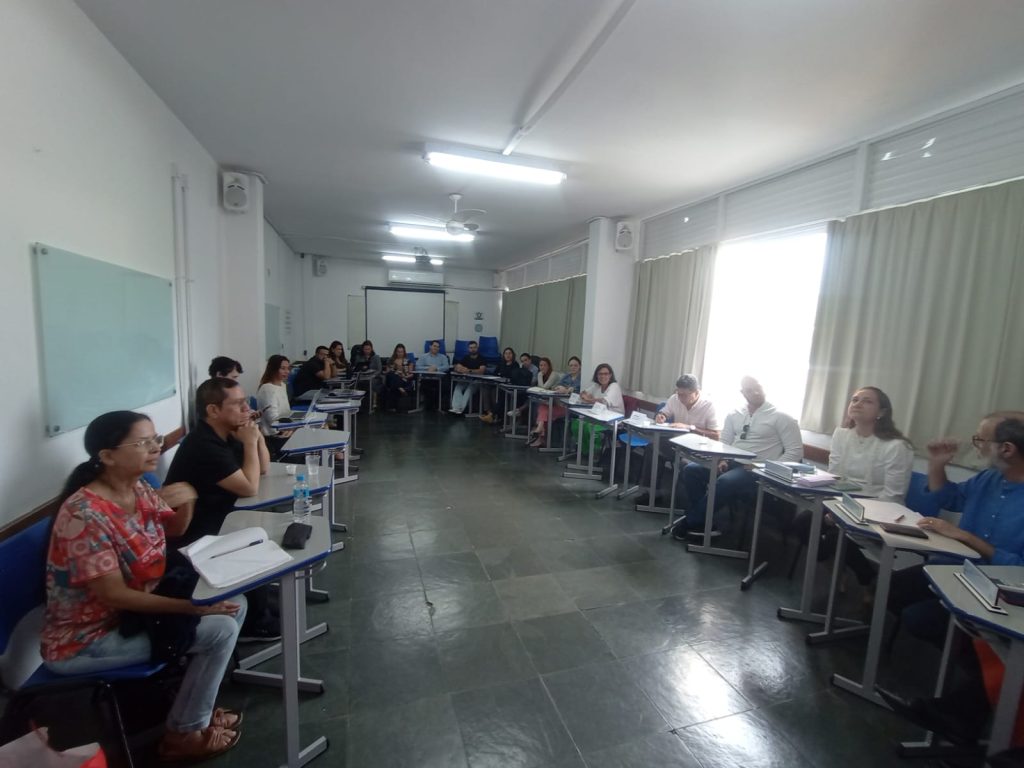
In this event, which took place from 11th to 15th August, Vanessa Pinto presented her international mobility experience at the University of Aveiro, in a partnership between DigiMedia and the Federal University of Rio de Janeiro.
The researcher had the opportunity to talk about the work that began during the exchange and is still ongoing. She also emphasized that international mobility offers a rich cross-cultural exchange, essential for growth both academically and personally.
Maria Júlia Vieira and Catarina Feio, PhD students in New Media and members of DigiMedia Research Center, attended the 7th Sopcom Young Researchers Meeting, held on July 9, 2025, at the Fernando Pessoa University in Porto.
During the event, Maria Júlia presented a poster entitled “Harassment and Toxic Culture in Video Game Live Streaming: Challenges and Proposals for a More Inclusive Environment”. Her presentation was featured in the poster session, which showcased innovative research into communication, digital culture and inclusion.
Catarina Feio presented the communication: “Youth, News and Social Media – the News Consumption Practices of Young People in Portugal”, part of her PhD research. The talk was part of the session on “Audiences and News”.
The meeting brought together young researchers from all over the country, encouraging the exchange of knowledge and debate on emerging communication issues, with sessions dedicated to visual culture, digital literacies, journalism and society.
The participation of Maria Júlia and Catarina Feio highlights the commitment of DigiMedia and the PhD Program in New Media in promoting research with social impact and relevance.
Malmö University in Sweden hosted the 7th edition of the AI and Games Summer School. Among the participants was Cláudia Vale Oliveira, a student in the New Media PhD Program and a researcher at DigiMedia, who participated in this edition marked by innovation, creativity, and critical reflection on the role of artificial intelligence (AI) in gaming.
During five days, engineers, programmers, researchers, and game designers from both academia and industry shared knowledge and discussed the latest trends and influences in the use of AI in game development. The researcher from the University of Aveiro (UA), in addition to perspectives on player experience and interaction with agents through natural language processing, particularly highlighted the role of generative AI in the creative process and the ethical issues and challenges that artificial intelligence raises in game development. Issues such as authorship, boundaries, and ethical responsibility reinforce the importance of training professionals who are aware and critical of the possibilities and risks of AI integrated into interactive design. She also emphasized that it was “an incredible and inspiring week,” an experience she found “both engaging and challenging.”
In the final days of the event, participants were challenged to participate in the Game Jam. In this context the researcher Cláudia Oliveira and her team developed the Baloonce prototype, a collaborative game that aims to create balance, combating the sedentary lifestyle and burnout associated with professions like gaming developers, designers, and researchers, exploring the importance of moving and coordinating the body in a world where the mind and digital world are pushed to their limits. The project stood out among the participating teams, being selected as the best project of the Game Jam, a recognition that highlights the talent and capabilities of those involved. The project will soon be shared on Github.
This event was guided by leading figures in the field, such as Georgios N. Yannakakis, Julian Togelius, co-authors of the book Artificial Intelligence and Games, and Antonios Liapis. It was made possible thanks to the support of King, the UA, and DigiMedia, which provided the doctoral student with the opportunity to participate in this international summer school.
For the UA community, this participation represents not only an opportunity to enrich the student’s curriculum, but also a contribution to the development of new lines of research in the fields of new media, immersive games, experience design, and the ethics of artificial intelligence.
Project n. 15 – Design an accessible flyer to support people with disabilities
About the project
This project aims to develop two accessible and informative flyers with the aim of promoting inclusion and awareness about disability and incapacity. It aims to support people with disabilities, their families, caregivers and professionals, and the community in general, by providing clear information about the different types of disability, technological resources, support services and inclusion strategies available in the country and at the University of Aveiro. It also aims to foster a culture of equal opportunities and active participation in society.
Participants
This project is coordinated by Francisca Lourenço (PhD student), with the participation of:
Rita Oliveira (DigiMedia researcher) Oksana Tymoshchuk (DigiMedia researcher) Anda-Elena Covaci (1st cycle degree in Multimedia and Communication Technologies) Mariana Veiga (Master in Communication and Web Technologies)
What do you expect from participating in the initiative?
“I hope to give visibility to the community of people with disabilities, acquire useful tools and knowledge for my academic life, and contribute to inclusion through a practical and impactful project” (Mariana)
“May this initiative bring more autonomy where it makes all the difference” (Anda-Elena Covaci)
The Conference ACM IMX 2025, co-organized by the University of Aveiro and the Universidade Federal Fluminense (Brazil), took place between 3rd and 6th June 2025, in Niterói, Rio de Janeiro, Brazil.
Jorge Ferraz Abreu, a Digimedia researcher, was one of the General Chairs of this conference, along with other members of the DigiMedia team: Pedro Almeida (demo chair), Telmo Silva and Carlos Santos (Web Chairs), Juliana Camargo (Publicity Chair) and Ana Velhinho (Acessibility Chair).
The conference had 22 full papers, 17 WiP, 17 Demos, 1 industry talk, and the participation of 6 doctoral students and 3 keynote speakers.
Maria João Antunes, a DigiMedia researcher, participated in the CISTI 25 conference – 20th Iberian Conference on Information Systems and Technologies (ISEG, June 16-19, 2025), with a paper entitled: “Digital Health Literacy in the Elderly: Exploratory Study in Senior Universities in Portugal”.
This paper refers to the study carried out between October 2024 and February 2025 by a PhD student and invited researcher, Vanessa Pinto, during her study period at DigiMedia. This same conference also addressed the work of the PhD student and researcher Renata Frade: “Women In Technology: A Case Study In Science Communication and Knowledge Management”. During the conference, it was possible to establish contacts with other researchers and see how the academic community is appropriating AI, in different research contexts.
Francisco Regalado, a PhD student in Information and Communication in Digital Platforms at DigiMedia, DeCA, UA, participated in the ACM International Conference on Interactive Media Experiences (IMX 2025), held in Rio de Janeiro, Brazil, from June 3 to 6, 2025.
During the conference, Francisco presented his full paper, “Co-creating with Older Adults is a Challenging Task! Lessons Learned from Real-Life Experiences and Challenges at an Ageing Lab” — available at https://doi.org/10.1145/3706370.3727865. The paper was co-authored with professors Ana Isabel Veloso and Carlos Santos.
The research explores a key part of Francisco’s thesis, based on insights gained through a series of activities conducted with older adults at the Laboratório do Envelhecimento (Ageing Lab). Based on these real-life experiences, the study presents a set of practical recommendations for effectively conducting co-design sessions with older participants.
The Impact of AI tools on the development processes of digital products for the Web was discussed on an event that took place on June 9, 2025, organized by the DigiMedia team.
The event had two sessions:
A discussion about the role of universities in training students who will enter a job market where AI tools are already a reality. This session was moderated by the DigiMedia Coordinator, Nelson Zagalo, and had the participation of two invited speakers: Celso Martinho (Cloudflare) and Benjamin Junior (Sonae).
Then, the objectives and action plan for the Master in Communication and Web Technologies (MCTW), as it relates to AI tools, was presented and discussed, by professors who teach at MCTW.
This event was an opportunity for DigiMedia researchers and professors of Science and Communication Technology to reflect on the the growing impact of artificial intelligence on academia and on the future job market of our students.
Beatriz Vieite, a PhD student in New Media and researcher at DigiMedia and at CESAM, attended the PCST 2025 Conference in Aberdeen, Scotland (UK) from 27th to 29th May 2025. The conference is promoted by the Public Communication of Technology Network (PCST) and this year was organized by the University of Aberdeen.
Beatriz presented a poster and a 3-minute talk on Portuguese biological collections and their potential for science communication. This study mapped the existing natural history museums and biological collections in Portugal, as well as the challenges and opportunities from science communication and public engagement of science, according to museums and collections staff (curators, managers, museum educators).
This work is part of Beatriz’s PhD thesis, supervised by Pedro Beça (DigiMedia/DeCA), Ascensão Ravara (CESAM/DBio) and Marina R. Cunha (DBio).
The Master in Communication and Web Technologies organized the open class “Launching and building digital products in an AI era”, on June 4th, with the participation of two former students of Multimedia and Communication Technologies: António Santos and Pedro Araújo, who became senior Web Developers and successful entrepreneurs, and creators of web products already available on the market.
The two invited speakers shared how they integrate AI tools throughout the design, development, and launch process of digital products.
This session was an opportunity for students to discover practical insights, tips, and tricks to supercharge their projects with AI.