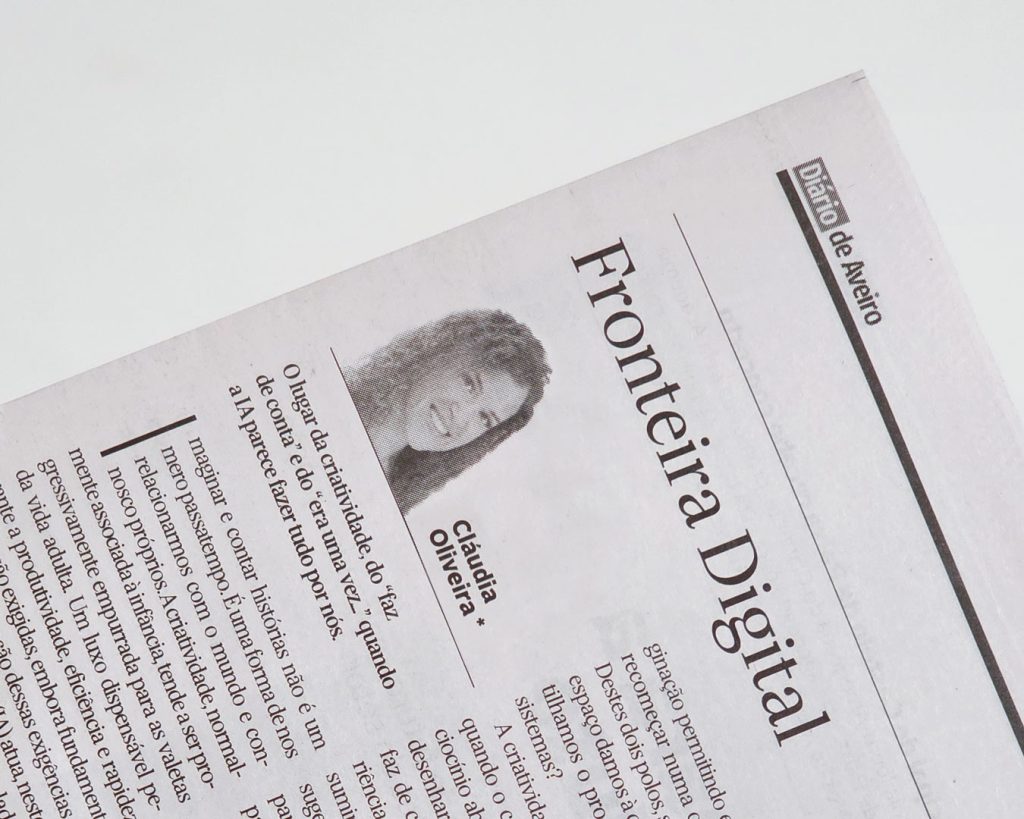
“O lugar da criatividade, do “faz de conta” e do “era uma vez…” quando a IA parece fazer tudo por nós” is the newest article of the DigiMedia opinion column “Fronteira Digital” in the newspaper Diário de Aveiro, written by Cláudia Vale Oliveira, a PhD student in New Media.
This text inspires reflection on the role of creativity in the age of artificial intelligence, highlighting the importance of integrating AI as a tool to enhance creative processes, without replacing reasoning, autonomy and agency, emphasizing the need to preserve imagination, authorship, and critical thinking in an increasingly automated world.
On Saturday, March 7, a pilot test of the Oh!Bug mobile application took place at Parque da Vila in Sever do Vouga, with the participation of members of the DigiMedia research unit.
The main goal of this test was to validate the methodology defined for the study “Engaging Young Students with Mobile Applications Focused on Sustainable Development and the Environment – The Case Study of the Oh!Bug Mobile Application.” This research is being developed by PhD candidate Sara Martins, under the supervision of Carlos Santos and David Oliveira, within the Doctoral Programme in Multimedia in Education.
This study aims to investigate the impact of interaction and geolocation systems included in mobile applications on children’s relationship with nature, through the implementation of field trips in which participants identify natural species using the Oh!Bug app.
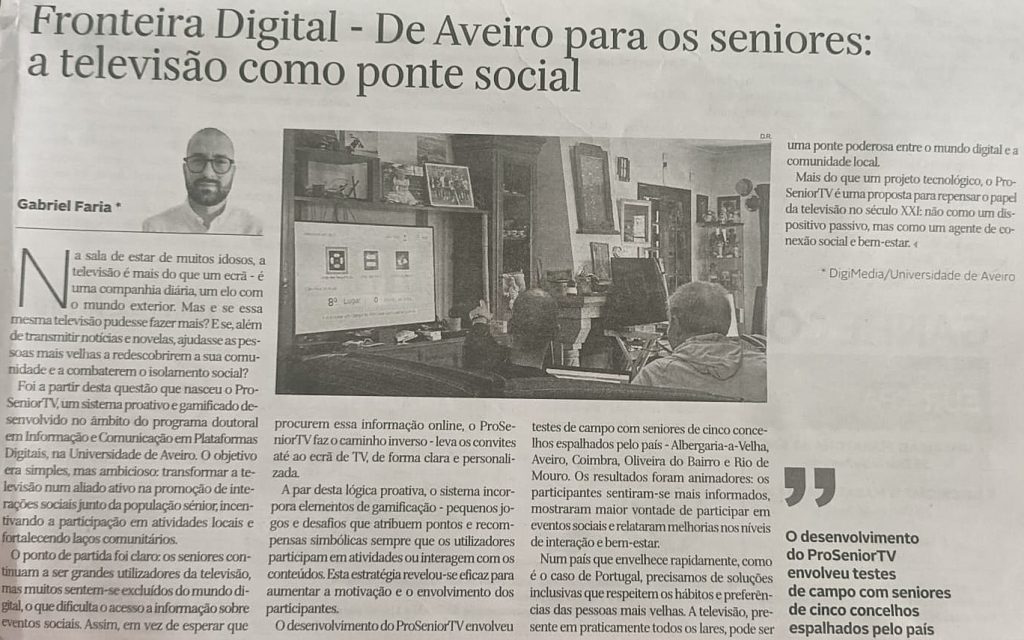
The most recent opinion article in Diário de Aveiro “De Aveiro para os seniores: a televisão como ponte social“, written by Gabriel Faria, highlights the ProSeniorTV, a project developed at the Universidade de Aveiro that explores how television can help reduce social isolation among older adults.
The column “Fronteira Digital” can be read on the first Wednesday of every month in the printed version. This is an opportunity to show the local community the themes we work on and the research carried out at DigiMedia.
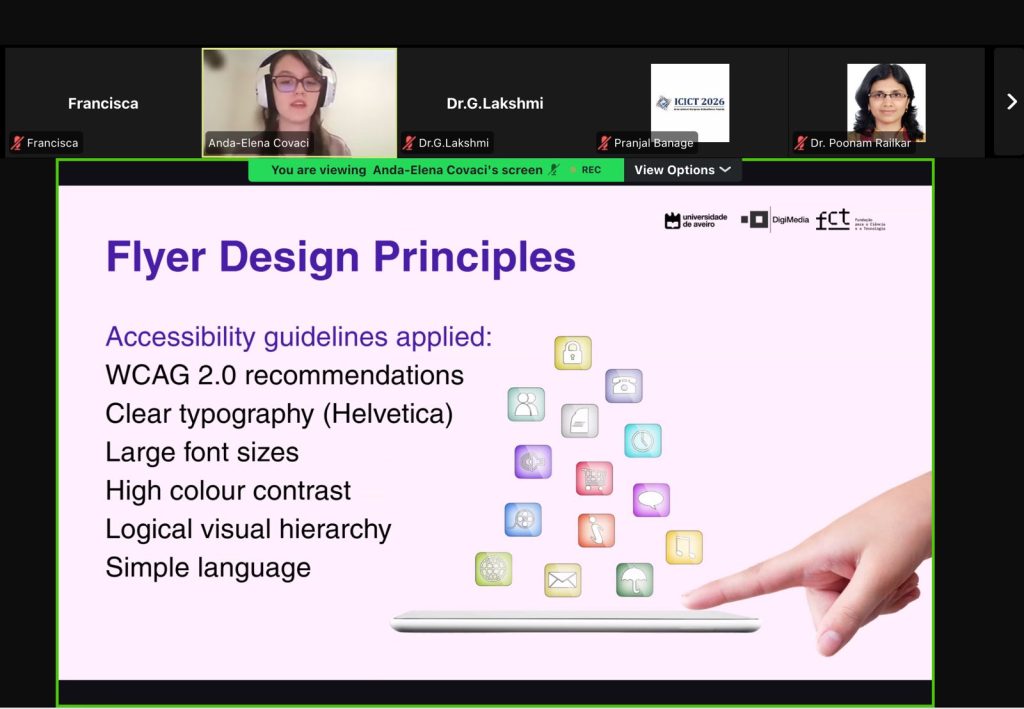
Anda-Elena Covaci, currently a second-year student in the Multimedia and Communication Technologies degree programme at the University of Aveiro, remotely presented a scientific paper on 27 February at the 11th International Congress on Information and Communication Technology (ICICT 2026), an international conference held in London, United Kingdom.
The paper, entitled ‘Inclusive Communication through Universal Design: Designing accessible informational flyers to promote awareness, resources, and support for People with Disabilities’, was developed as part of the Students@Digimedia #04 initiative, resulting from research conducted by the student in collaboration with the research team at DigiMedia’s UAInclusive Laboratory.
The research focuses on applying the principles of Universal Design to the creation of accessible informational flyers, with the aim of promoting more inclusive communication and facilitating access to information, resources, and services for people with disabilities. The work highlights the importance of inclusive design as a tool for reducing informational barriers and reinforcing user-centred communication practices.
The Students@Digimedia initiative aims to promote the active involvement of students in scientific research activities, encouraging the development of academic skills and participation in international scientific events. The presentation at ICICT 2026 is yet another example of the collaboration between teaching and research at the University of Aveiro, highlighting the impact of the work carried out within the scope of DigiMedia.
The DigiMedia Laboratories, LabUA Inclusive and Lab XR, hosted a group of young adults with diverse support needs from the Organization “Pais em Rede” for a co-creation session focused on developing accessible Virtual Reality (VR) games.
The PhD student Débora Dias and the master’s student Rita Simões led the initiative, under the guidance of Professor Mário Varinhos and researcher Oksana Tymoshchuk. The session aimed to involve participants in designing inclusive solutions by valuing their experiences and perspectives.
The young people actively contributed ideas, suggestions, and feedback, providing essential input for a VR game designed to help students with autism participate in team sports. This co-creation approach reinforces the importance of involving end users in designing inclusive technologies, ensuring solutions effectively meet their real needs.
This initiative demonstrates the laboratories’ commitment to promoting inclusion through technological innovation and creating more accessible, equitable digital experiences for all.
DigiMedia researcher, Filipe Moreira, was the author of the opinion article “A relação professor-aluno: um património humano a valorizar”, written on the printed regional newspaper of Ovar – João Semana.
Filipe Moreira writes about the teacher–student relationship, as a vital human heritage, essential to quality education, social equity, and the future of democratic societies. Read the article below.
—————————————-
A relação professor-aluno: um património humano a valorizar
Há relações humanas que atravessam gerações, culturas e sistemas políticos sem nunca perderem relevância. A relação entre professor e aluno é uma delas como é a de educador e criança. Não se trata apenas de uma ligação funcional, mediada por currículos, programas ou avaliações. Trata-se de uma relação profundamente humana, muitas vezes estruturante da identidade individual e até coletiva de uma comunidade.
Milhões de crianças e jovens, em todo o mundo, têm nos seus professores/educadores as primeiras grandes referências fora do núcleo familiar e em muitos casos a única referência com formação superior (fator que possivelmente também contribui para que crianças de famílias socialmente mais desfavorecidas sigam a área da educação em Portugal). São eles que ensinam a ler e a escrever, ensinam Matemática, História e outras áreas, mas também a pensar diferente, a questionar, a respeitar o outro e a compreender o mundo. Por isso, a figura do professor/educador ultrapassa largamente os limites da sala. De tal forma que a um docente exige-se um comportamento exemplar não apenas no exercício da sua profissão, mas também na esfera pública e privada, numa exigência ética que não é colocada, com a mesma intensidade, a muitas outras profissões.
Esta expectativa social revela algo essencial: o professor/educador não é visto apenas como um técnico do ensino, mas como um modelo de cidadania. Cada gesto, cada palavra, cada atitude pode deixar marcas duradouras e pode influenciar o futuro de uma criança. É uma responsabilidade imensa, tantas vezes invisível e raramente acompanhada do reconhecimento social e material que lhe corresponderia.
Ao mesmo tempo, os professores e os educadores são o verdadeiro motor dos sistemas educativos. Nenhuma reforma curricular, nenhuma inovação tecnológica, nenhuma política pública tem impacto real sem contar com estes profissionais qualificados, motivados e valorizados. São ainda agentes de transformação da sociedade, aqueles que, no quotidiano, traduzem grandes princípios em práticas concretas. Por isso, se queremos sociedades mais justas, mais críticas e mais democráticas, precisamos inevitavelmente de mais professores, mas acima de tudo de bons professores.
É precisamente aqui que se revela uma das maiores contradições do nosso tempo. Nunca se falou tanto da importância da educação e, paradoxalmente, nunca foi tão difícil atrair e reter professores. Segundo estimativas da UNESCO, o mundo precisará de cerca de 44 milhões de novos docentes até 2030 para garantir uma educação de qualidade para todos. Esta escassez afeta tanto países ricos (onde se engloba Portugal) como países em desenvolvimento, sendo particularmente grave na África Subsaariana e no Sul da Ásia.
As causas são conhecidas e persistentes: baixa atratividade da carreira, salários pouco competitivos, excesso de burocracia, sobrecarga de trabalho, falta de apoio institucional e desgaste emocional. Muitos professores abandonam a profissão em busca de melhores condições noutros setores, levando consigo experiência, saber pedagógico e estabilidade relacional — elementos fundamentais para a qualidade educativa.
As consequências são profundas. A falta de professores compromete o acesso universal à educação, aumenta o número de alunos por turma, fragiliza o acompanhamento individual e acentua desigualdades sociais. Mais grave ainda, transmite-se às novas gerações a ideia de que ensinar é uma missão nobre, mas pouco valorizada — uma visão que corrói o próprio futuro da educação.
Por isso, quando se discute o reconhecimento da relação professor-aluno como património da humanidade – como se discutiu e aprovou a proposta de considerar a Relação Professor-Aluno como Património da Humanidade apresentada e defendida pela Internacional da Educação (IE) e pela Fenprof na Conferência Mundial sobre os docentes (organizada pela UNESCO), que se realizou em Santiago do Chile no ano passado – a reflexão não pode ficar pelo plano simbólico. Reconhecer esta relação é reconhecer que não há educação de qualidade sem professores qualificados, respeitados e apoiados. É exigir mais professores, sim, mas sobretudo melhores condições para que possam exercer plenamente o seu papel. Acrescento ainda que, considerando a complexidade da profissão e o impacte que poderá ter nas vidas futuras das crianças e jovens, ter pessoas a lecionar sem competência para tal não deveria ser permitido.
Bem sabemos que o mundo de hoje é acelerado, dominado por métricas, resultados imediatos e soluções tecnológicas, mas ainda vale a pena parar e pensar: que sociedade estamos a construir se não cuidarmos daqueles que educam? Que sociedade estamos a criar se não temos os melhores e os mais qualificados a educar as nossas crianças? Proteger e valorizar a relação professor-aluno ou educador-criança é, em última instância, proteger a própria ideia de futuro.
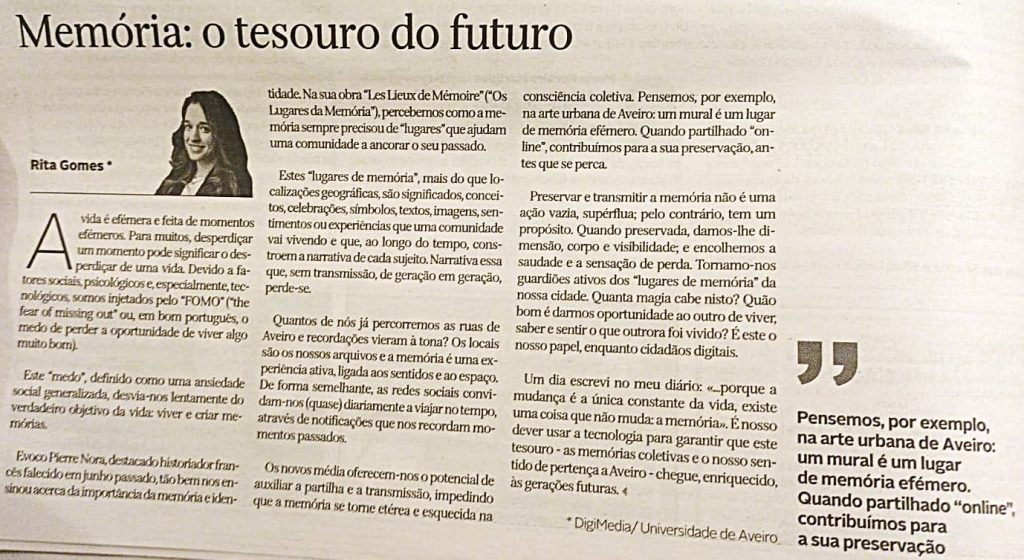
“Memória: o tesouro do futuro” is the newest article of the DigiMedia opinion column “Fronteira Digital” in the newspaper Diário de Aveiro, written by Rita Gomes, a PhD student in New Media. The text explores the issue of the preservation of memory in the digital age and can be read here.
The article “Fronteira Digital” can be read on the first Wednesday of every month in the printed version. This is an opportunity to show the local community the themes we work on and the research carried out at DigiMedia.
The DigiMedia researcher Oksana Tymoshchuk outlined the mission of the UNI.AO Programme, in which the University of Aveiro is collaborating in the design of the first doctoral programme in Education in southern Angola, at the University of Huíla.
The DigiMedia researcher participated as a supervisor for three PhD students in the area of Educational Technologies, and promoted a seminar on the use of qualitative data analysis technologies, such as WEBQDA and some Artificial Intelligence tools.
The UNI.AO Programme, funded by the European Union with €13 million, supports the Angolan higher education system in the production of knowledge and the promotion of innovation. Implemented by the French technical cooperation agency Expertise France, the programme aims to contribute to the training of qualified professionals capable of addressing the country’s current and future challenges through the creation of new postgraduate programmes, research funding, and capacity-building initiatives in key areas.
In this text, the author critically examines a manifesto advocating for the ban of generative artificial intelligence in Portuguese universities and argues for a more nuanced and informed approach.
The article highlights the importance of AI literacy, ethical reflection, and the adaptation of pedagogical practices to contemporary technological realities in higher education.
DeCA hosted the 4th edition of the Seminar ‘Emerging Topics in Multimedia in Education’, organized by students from the Doctoral Programme in Multimedia in Education, with the involvement of Carlos Santos (DigiMedia) and Margarida Lucas (CIDTFF).
This year’s edition took place on 17th January, under the theme “Reimagining Innovation in Learning with Artificial Intelligence”, focusing on innovative practices incorporating Artificial Intelligence. The invited keynote speaker was Luís Borges Gouveia, from Fernando Pessoa University.
Dozens of teachers interested in the topic, as well as many researchers from DigiMedia and CIDTFF, attended the event.