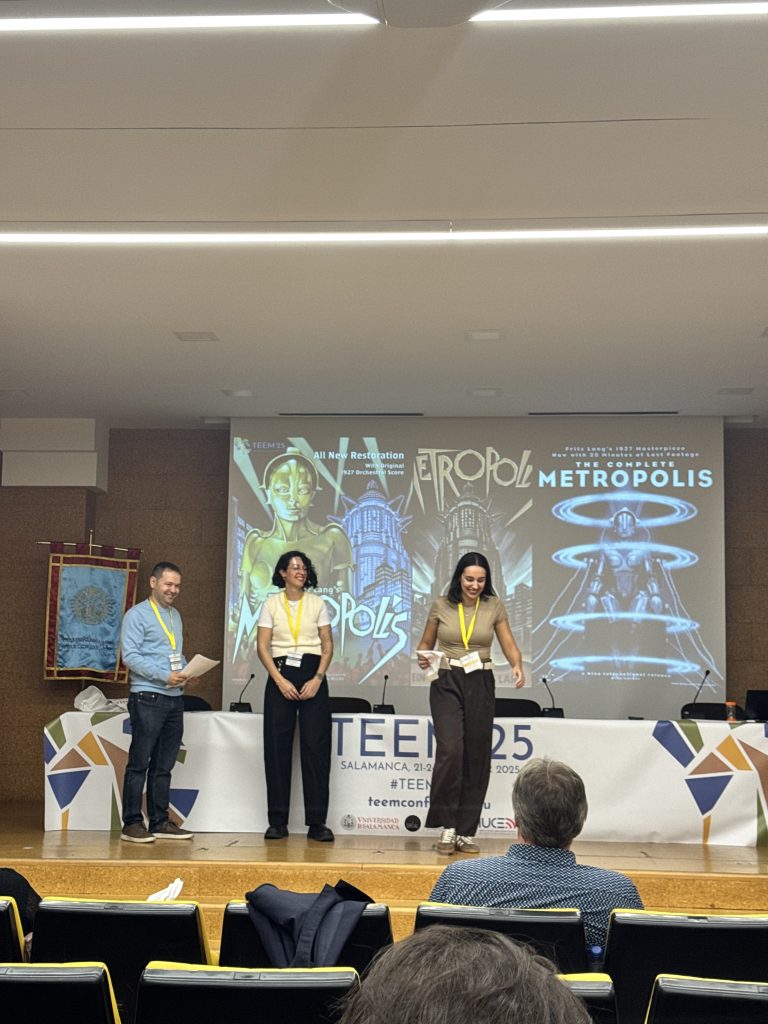
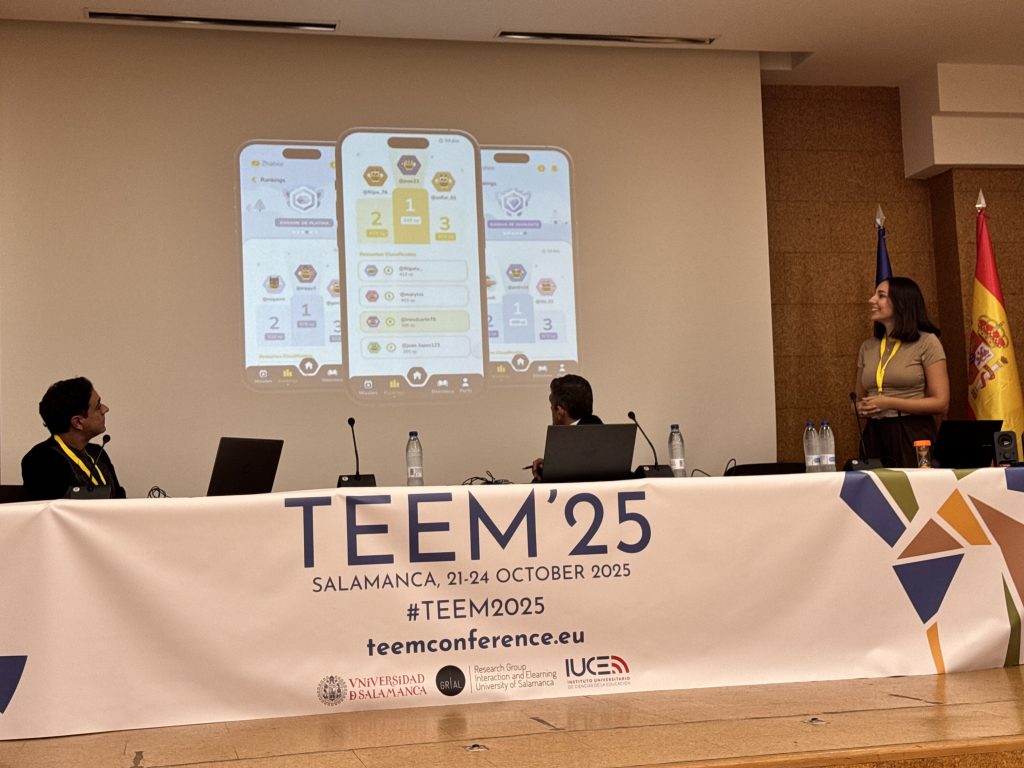
The paper “Zhabee: Empowering Teen Health Literacy through an Interactive App for Cancer Prevention”, presented at the 13th edition of the TEEM 2025 International Conference – Technological Ecosystems for Enhancing Multiculturality, received two awards: Best Paper and Best Presentation in Track 3 – Global Transformation in Healthcare: Integrating Cutting-Edge Technologies for a Multicultural Future.
The paper includes as co-authors two integrated researchers from DigiMedia, Ana Patrícia Oliveira and Telmo Silva, who supervised the final project in Multimedia and Communication Technologies that gave rise to this research.
The paper was presented at the conference by Sara Pombo, one of the co-authors. Henrique Policarpo and Marta Silva were also co-authors and members of the team that developed the project.
The Zhabee project aims to promote health literacy among teenagers through an interactive app for cancer prevention, combining user-centred design, gamification, and validated educational content.
This international distinction reinforces the excellence and visibility of DigiMedia in the field of interactive technologies applied to health and education.
Maria Vasconcelos, PhD student in New Media and member of DigiMedia Research Center, and her main supervisor, Catarina Lelis, attended the EUKO Annual Conference 2025, whose theme was “Storytelling in Business Communication”, and was held October 23-25, in London.
Maria presented the paper “From Stories to Sustainability: Exploring Tourism Narratives in Portugal’s Inland Regions,” which was part of her PhD research. The research analyzed two case studies, ADRIMAG (Associação de Desenvolvimento Rural Integrado das Serras do Montemuro, Arada e Gralheira) and Story Studio Accommodation Network, exploring how their communication strategies incorporate storytelling practices that reflect sustainability and regional identity. The presentation demonstrated how these narratives can enhance the visibility of local cultural and natural heritage while promoting responsible tourism practices that positively impact community development. The conference brought together researchers, professionals, and academics from diverse fields, providing opportunities for discussion, feedback, and the exchange of ideas on storytelling.
Malmö University in Sweden hosted the 7th edition of the AI and Games Summer School. Among the participants was Cláudia Vale Oliveira, a student in the New Media PhD Program and a researcher at DigiMedia, who participated in this edition marked by innovation, creativity, and critical reflection on the role of artificial intelligence (AI) in gaming.
During five days, engineers, programmers, researchers, and game designers from both academia and industry shared knowledge and discussed the latest trends and influences in the use of AI in game development. The researcher from the University of Aveiro (UA), in addition to perspectives on player experience and interaction with agents through natural language processing, particularly highlighted the role of generative AI in the creative process and the ethical issues and challenges that artificial intelligence raises in game development. Issues such as authorship, boundaries, and ethical responsibility reinforce the importance of training professionals who are aware and critical of the possibilities and risks of AI integrated into interactive design. She also emphasized that it was “an incredible and inspiring week,” an experience she found “both engaging and challenging.”
In the final days of the event, participants were challenged to participate in the Game Jam. In this context the researcher Cláudia Oliveira and her team developed the Baloonce prototype, a collaborative game that aims to create balance, combating the sedentary lifestyle and burnout associated with professions like gaming developers, designers, and researchers, exploring the importance of moving and coordinating the body in a world where the mind and digital world are pushed to their limits. The project stood out among the participating teams, being selected as the best project of the Game Jam, a recognition that highlights the talent and capabilities of those involved. The project will soon be shared on Github.
This event was guided by leading figures in the field, such as Georgios N. Yannakakis, Julian Togelius, co-authors of the book Artificial Intelligence and Games, and Antonios Liapis. It was made possible thanks to the support of King, the UA, and DigiMedia, which provided the doctoral student with the opportunity to participate in this international summer school.
For the UA community, this participation represents not only an opportunity to enrich the student’s curriculum, but also a contribution to the development of new lines of research in the fields of new media, immersive games, experience design, and the ethics of artificial intelligence.
The Conference ACM IMX 2025, co-organized by the University of Aveiro and the Universidade Federal Fluminense (Brazil), took place between 3rd and 6th June 2025, in Niterói, Rio de Janeiro, Brazil.
Jorge Ferraz Abreu, a Digimedia researcher, was one of the General Chairs of this conference, along with other members of the DigiMedia team: Pedro Almeida (demo chair), Telmo Silva and Carlos Santos (Web Chairs), Juliana Camargo (Publicity Chair) and Ana Velhinho (Acessibility Chair).
The conference had 22 full papers, 17 WiP, 17 Demos, 1 industry talk, and the participation of 6 doctoral students and 3 keynote speakers.
Maria João Antunes, a DigiMedia researcher, participated in the CISTI 25 conference – 20th Iberian Conference on Information Systems and Technologies (ISEG, June 16-19, 2025), with a paper entitled: “Digital Health Literacy in the Elderly: Exploratory Study in Senior Universities in Portugal”.
This paper refers to the study carried out between October 2024 and February 2025 by a PhD student and invited researcher, Vanessa Pinto, during her study period at DigiMedia. This same conference also addressed the work of the PhD student and researcher Renata Frade: “Women In Technology: A Case Study In Science Communication and Knowledge Management”. During the conference, it was possible to establish contacts with other researchers and see how the academic community is appropriating AI, in different research contexts.
Beatriz Vieite, a PhD student in New Media and researcher at DigiMedia and at CESAM, attended the PCST 2025 Conference in Aberdeen, Scotland (UK) from 27th to 29th May 2025. The conference is promoted by the Public Communication of Technology Network (PCST) and this year was organized by the University of Aberdeen.
Beatriz presented a poster and a 3-minute talk on Portuguese biological collections and their potential for science communication. This study mapped the existing natural history museums and biological collections in Portugal, as well as the challenges and opportunities from science communication and public engagement of science, according to museums and collections staff (curators, managers, museum educators).
This work is part of Beatriz’s PhD thesis, supervised by Pedro Beça (DigiMedia/DeCA), Ascensão Ravara (CESAM/DBio) and Marina R. Cunha (DBio).
The DigiMedia coordinator, Nelson Zagalo has written an opinion piece in the online newspaper Jornal de Notícias, entitled “Do ruído à afinidade”, where he reflects on the new era of social networks.
The DigiMedia researcher Hélder Caixinha presented the video “I Want to Play the piano”, in the CHI Conference (Conference on Human Factors in Computing Systems), that took place in Yokohama – Japan, on April 25.
The video was based on the Doctoral Thesis of the DigiMedia researcher Davys Moreno, “Inclusion of children with cerebral palsy in arts education programmes: from research to action”.
Catarina Lélis has just completed her mobility program at KU Leuven, in Belgium, where she had the opportunity to strenghten the existing network. The DigiMedia researcher gave a lesson on visual strategies for UI/UX, a taster on the Impact Plan and led a workshop on dynamic Visual Identities.
In addition, Catarina Lélis participated in a workshop organized by Mintlab, a research unit of the Faculty of Social Sciences, with whom DigiMedia share several research interests.
FCT announced the provisional results of the evaluation of the Multiannual Program for Financing R&D Units (UID) for 2025-2029, on April 15, 2025. DigiMedia was classified as Very Good by the Computer Sciences and Information Technologies Panel. This result was possible thanks to the effort and dedication of the entire team, demonstrating the quality of the work and research carried out in the area of Digital Media and Interaction.